
ACADEMY VIEWING FILMS: 3

Surprise!
We’re going to begin with a film written by two Australians, Mirrah Foulkes and David Michôd, and directed by the latter.
Really? you ask.
And what have the Australians brought to us this year?
The film, produced and distributed by Yoki, Inc., Votiv, Fifty-Fifty Films, and Black Bear Pictures, is about the first woman American boxer to be lauded by the sporting world: Christy Martin.
And it’s called Christy.
And it stars Sydney Sweeney.
It opened to the worst box-office of the year.
And that was because of the American Eagle saga taking a dump over the potential audience.
I only heard about the brouhaha as more of a ha than a brou and even less than a haha. I didn’t follow it. All I knew was that a pair of blue jeans turned into some sort of argument about genetics, and the wearer of the blue jeans had blonde hair and blue-eyes, and Trump jumped into the brouhaha because it was the weekend, the golf course was wet, and the builders were clearing out the East Wing or something, so he could drool over a woman even younger than Pam Bondi or Ms Leavitt, the whole thing was shit, and I only saw a picture of Sydney Sweeney, I didn’t know her or her work, so I shrugged it off.
But when the Academy posted this week’s batch of streamers there was Christy, and I thought, “That’s with that girl, the one from the jeans brou or haha,” and there she was, in the movie ad, in some pink robe and her boxing gloves were up, so I turned on the film, figuring that I’d do ten or fifteen minutes, Sydney Sweeney, let’s see what she’s like.
And I was surprised.
More than surprised.
In the first scene of Christy, there was a slightly chubby young girl with close-cropped brown hair, having dinner with a taciturn father, a quiet and sullen brother, and a dreadful, dreary, mean-spirited mother who could suck the spirit out of everyone with a look and a fancy self-regard. She was quietly telling her daughter, Christy, to stay away from another girl in her school, because there was talk about the both of them in the community, and the slightly chubby young girl with the close-cropped brown hair tried to fight her mother’s meanness - but such things were not meant to be talked about, ever, in her mother’s America…and I thought, “Wow…This is a family that hurts…And a young girl that is being harmed to her soul…”
Sydney Sweeney was Christy Martin.
And I was hooked.
In that first scene, Sydney Sweeney promised a surprising characterization, and an astonishing and emotionally appealing performance.
This film is based upon the life and career of Christy Martin, who became the first famous lady boxer, and who eventually was forced, by the antagonism of family, and violence of her husband - by fighting death itself! - to ‘come out,’ and eventually to marry her former boxing adversary, Lisa Holewyne.
The film is about fighting: fighting social norms, fighting misogyny, fighting other lesbians by fighting one’s self as a closeted lesbian, but finally coming into one’s own by fighting the world, and defeating it.
The film, as they say, takes no prisoners. It is not self-indulgent. It does not wink at the screen or pander to the situation, characters and, therefore, the audience. It deserves more than a one or two million dollar take at the box-office.
In other words, it is very much worth seeing.
The writing is solid, moving, emotionally and craftily presented and performed. Sydney Sweeney is a writer/director’s dream. She not only delivers the character, she inhabits it with a tough intelligence, and with the certainty of a consummate professional. In this role, she cannot be compared with any other actress. She has made Christy her own vital and broken creation, fighting her own demons as she enters the ring, and all the demons of the world beyond the ring: her husband, her family, but most importantly, herself, as false, self-hating, and as insincere as the world that has imposed itself upon her.
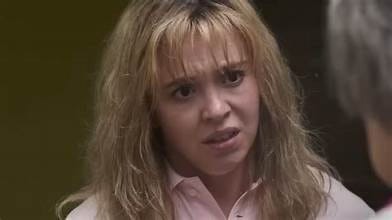
Christy is a battler, however, and has to confront and defeat a world that is much more difficult and despairing and realistic than the world of any other boxer portrayed in film: for she is a closeted lesbian whose spirit and a heart is constantly being challenged, if not constantly being wounded as much by herself as by others.
Besides Sydney Sweeney, the other principal performances in Christy are also lessons in the actor’s art:
Ben Foster, as Jim Martin, Christy’s trainer and husband, plays a soft-voiced sociopath with chameleon-like fluidity, at once tongue-tied and sentimental, then whisperingly terrifying in his words and actions.
Merritt Wever, as Christy’s mother, is the perfect social hypocrite, living in a world of her own choosing, and demanding those choices upon all members of her family. Her pauses, “with societal implications,” are comically terrifying, and deserve study by the acting community.
It is a tribute to the actress Sydney Sweeney to not only survive scenes with these two actors, but also to return their serves with the emotional value of her character, and the canny vigor of her craft.
Don’t let the bizazz of social media or the gossip of the internet do your thinking for you: Christy is a work that deserves to be seen, and its makers to be respected, and honored.
Nuremberg is brilliantly shot by Darusz Wolski, its production richly designed by Eve Stewart, and often grandly directed by James Vanderbilt.
But it is Russell Crowe, as the malignant narcissist, Reichsmarschall Herman Göring, who fills the screen.
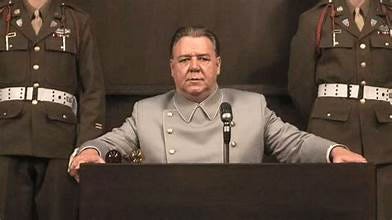
One day, my film MAR-A-LAGO, the epic political thriller, will be brilliantly shot for the world’s theater. Once again, Russell Crowe will play another malignant narcissist and sociopath. This time, he will be Reichsmarschall Drumpf.
Goring’s responsibility for the deaths of six million Jews, and the “establishment of more than 40,000 camps for the imprisonment, forced labor, and mass killing of Jews, Sinti and Roma, Communists, and other so-called “enemies of the state ” will resonate in today’s more-than-modern establishment of camps, built to hold “insane criminal drug-taking rapist Latinos, stoned blacks, and everyone who eats cats and dogs,” as well as other so-called “enemies of the state” who are critics of the Reichsmarschall Drumpf and his Icy Gestapo, set loose like rabid dogs in the land in which the spectacular MAR-A-LAGO takes place - Drumpf’s own present-day version with his own present-day version of the Gestapo, but without the Gestapo’s snazzier outfits - in a falling-down, poor man’s version of Orson Welles’ Xanadu!
In MAR-A-LAGO, besides Russell Crowe as the reincarnation of Göring, John Goodman will play Tom Homan, Kate McKinnon will be Stephen Miller, and Kylie Jenner, will be lauded for her feisty portrait of the botox-a-minute pet-shooting multi-dimensional album cover, Kristi Noem.
The horror of my black comedy, MAR-A-LAGO, is that the Nazi politics and Nazi leadership, as dramatized in Vanderbilt’s Nuremberg, thoroughly parallels today’s MAGA horror-show.
Göring’s analysis of Hitler and Nazidom, in Nuremberg, easily describes the Heritage Fund’s Project 2025, the contempt for democracy and its laws, the hatred, expulsion and eventual death of “the Other,” in Gestapo-like roundups for the camps, which means the hatred, expulsion and eventual death not only of non-whites in America, but also of any and all opposition to the paranoia of the Reichsmarschall Drumpf of MAR-A-LAGO, coming soon, to a theater near you. (Don’t be confused by the Mamdani coming attraction, no matter how attractive! Who in his right mind has sociopolitical discussions with Nazis?)
But to Nuremberg:
The psychiatrist, Dr. Douglas Kelley - whose role was to analyze the Nazi High Command’s psychoses, and who “befriended” Göring, opines, at the end of Nuremberg, that the Nazi phenomenon is not an aberration, but can and will happen anywhere - just as easily, he warns, in the United States. The Cold War will eventually give the sometimes democratic nation over to a Leader who will divest the country of its rules of law. The handing of every Life Decision to the Leader is not and will not be peculiar to Germany, Kelley expresses. The Nazis were not monsters. Horrifyingly, they were all too human. Kelley agrees with Hannah Arendt, who called the Third Reich’s, its works and personnel, “the banality of evil.”
Kelley’s own study of his Nuremberg experience, 22 Cells in Nuremberg, found no publisher. The “humanization” of what the West had considered non-human terrified and angered the media and the publishing world.
We were, after all, the good guys.
(America, so Reichsmarschall Drumpf says, is always first, and under his Reichsmanship will be made great once again! (“Ich werde Amerika wieder groß machen!” - shouts Drumpf, during the first scene in a montage of twenty-two failed assassination attempts upon his person.)
Eventually, like Göring, Kelley himself committed suicide, and in the same way: with potassium cyanide.
Nuremberg, the movie, is based upon the book by Jack El-Hai, “The Nazi and the Psychiatrist,” and follows Göring’s capture by the American troops, through the development of the Nuremberg trials, which buttresses Göring’s growing relationship with Kelley while in captivity. Because the film’s dramatization focuses more on the relationship between Göring and the psychiatrist than on the politics and ferment of the allies themselves in the Nuremberg Trials, the latter almost becomes a secondary issue to the drama.
The principal idea of the Nuremberg Trials was to form the world’s first collective of justice, through laws that would define, forever, the world’s responsibility to ensure the end of totalitarianism.
(This would help give rise to the United Nations, and to the International Court of Justice —which, at present, is charging six leaders with crimes against humanity: Vladimir Putin, Benjamin Netanyahu, the Philippines’ Rodrigo Duterte, Min Aung Hlaing of Myanmar, Laurent Gbagbo of the Ivory Coast, and Omar El Bashir, the former President of Sudan. It is the duty of the nations of the world to arrest those leaders, and to bring them to the International Court to face charges of war crimes. (Reichsmarschall Drumpf is working towards a charge as well, with his simultaneous planned and dreamy invasions of Venezuela, Colombia, Mexico, Greenland, and Panama!)
At present, we have rolled out the red carpet for Putin, in Alaska, on American soil, and continue to harbor Netanyahu every time he comes to DC. He has even addressed Congress, while we have done nothing to honor the charges of the International Court of Justice, and to nail those two motherfuckers .
Kelley was right. The face behind the Nazis and its dogma remains a universal one. Nuremberg should be seen by everyone in America, especially the young in America, and the old in Congress. It is a needed history lesson in a nation in which history is no longer taught, or is taught fearfully, reduced to second-by-second soundbites and the so-called Truths Social of Reichmarschall Drumpf and his comic-strip regime - which was formerly and far more often, and more admirably described, as the office of the Presidency and its Administration.
Rami Malek plays Dr. Kelley - to my mind with an overdose of Method and scene-grabbing eccentricities. (I thought his Freddy Mercury portrayal was far more effective, and much less self-conscious). Michael Shannon, who plays Robert Jackson, an associate justice of the Supreme Court and America’s principal prosecutor in the Nuremberg Trials, delivers his portentous dialogue with consistently furrowed brows and portentously theatrical oratory.
I hold the director, James Vanderbilt, responsible for the performances. The director, after all, is the one who says, “Cut.” It’s his call. In this case, the director also wrote the script. In the actual shooting, and in the script’s editing, he was and is the work’s only audience. As a screenwriter, Vanderbilt’s exposition is constant, and too often on-the-head. Granted, there’s a giantful of material that must be dramatized, but to my mind it could have been even more character and less ‘portentous event’ - driven.
In spite of that, the themes of the drama of Nuremberg are powerful, and achingly relevant, and the spectacle itself as moving as it is harrowing: for there is Nuremberg itself, its event and meaning, with Russell Crowe as Göring at its dramatic center.
That alone is very much worth the price of admission.
A few words about Wicked and Wicked: For Good:
(a fifth viewing of the former, and first view of the latter)
Kae and I went to our Apple Theater on November 20, the day before Wicked: For Good’s official opening. Instead, both parts of the two-part drama were playing, in a special screening, at 2:30 in the afternoon. Tuesday.
Eight people in the theater.
Five in costumes: 2 Elphabas, 1 Galinda, 1 ruby slipper and a yellow brick road.
Perfect.
We had bought seats in the first row, which was our mistake. Then changed our tickets, and moved to the rear of the theater. Between the size of the screen and the over-kill of speakers, placed, seemingly, every five feet on the ceiling and walls, we had a better chance of seeing and hearing a more balanced projection.
Wicked came first, obviously.
What is there to say?
Our fourth viewing.
It is one of the most perfect films ever made: inspired cast, inspired direction, inspired production. Tears flowed, and quiet laughter, and love for Elphaba’s revolutionary role, and the steady crack and tearing apart of Glinda’s narcissism, the gathering realization that the Wizard is a Trumpian fraud, and Munchkin-land, as well as Oz, containing easily manipulated student and lumpen proletariat fascists.
There is no greater revolutionary anthem than Elphaba’s Defying Gravity, and no greater duet in film history.
Wicked: For Good was as happily driven as Wicked, with grand enthusiasms and overwhelming yearnings and commitments. However, Wicked: For Good appeared to be overwhelmingly ‘adult,’ which implied that Wicked: For Good, would mean dark and plot-driven events meant to stun adolescents out of their childhood; it was, for me, a film that was dizzyingly multi-taled, with Dorothy, the Scarecrow, the Cowardly Lion and Tin Woodsman creeping as shadows throughout the landscape, and with betrayals and character revelations cutting through and eventually drowning out the revolutionary theme and rapture of Defying Gravity, as if that anthem were simply an adolescent’s skin problem.
With the Wizard gone, and Glinda on the throne, all but the Munchkins and Ozians (as well as Glinda and Elphaba) became ostensibly ‘sadder but wiser’ and ‘For Good.’ The Trump/Wizard may have been exiled, and Madame Morrible arrested, but giving in to compromise and mediocrity - finally, and as always -wins the day in the world of adults. (Unless the third film of the proposed series leads us elsewhere! I’d thought, after all, that the emotional agreement between Glinda and Elphaba at the end of Wicked would prepare us for a crafty and revolutionary take-over of Oz. by Elphaba and a craftier Glinda. However, The craftier and more revolutionary screenwriter, Stephen, was proved wrong!)
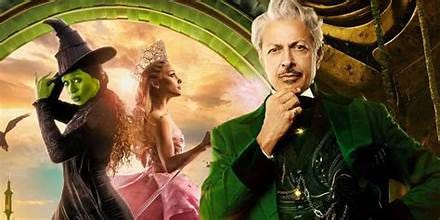
In Wicked: For Good, the heroines are put down at every level by the dulling stupidities of the Wizard and Oz, until Elphaba herself urges Glinda to lie, to the world, about the “wicked witch.” Keep the mantra flowing. She herself paraphrases the Wizard’s own Trumpian dialectic: to make everyone feel good about the world by giving them a common enemy. Let Elphaba be Wicked for good, so Glinda can remain Goody-good for ‘good,’ and, who knows, perhaps become somewhat better.
Are you serious?
I detested that giving-up in Wicked: For Good, and on which the universe of Oz ultimately turned. I cannot imagine a world spiritually, emotionally and intellectually evolving without artists, scientists, philosophers, social revolutionaries and lovers actively, enthusiastically and defiantly taking to the air.
I’d rather be dead than ever cease Defying Gravity.
Glinda’s sadder-but-wiser revelation will never create a new kind of sonnet, or move us any closer to a definition of Quantum Gravity!
Although I adore Ariana Grande, who is the most adorable creation in contemporary film, let us not forget that Glinda herself, as portrayed in both Oz Journeys, is an adorable but pathetic narcissist. And Elphaba herself, - (at least in this second film, but with a third on the way, so there’s doubtlessly more to be said, as there’s more to come) - has seemed to have given up, to have become a denier of her own magic.
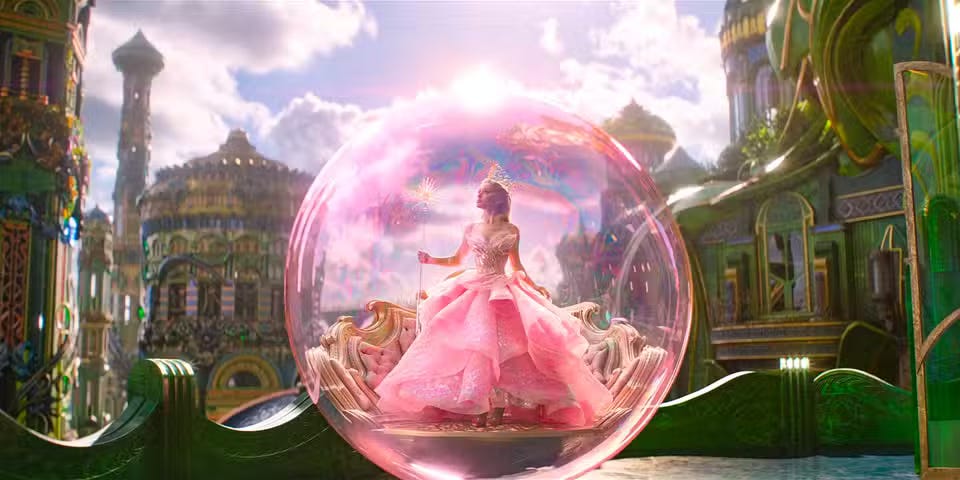
Thus, in the finale of the second film: Glinda, now Queen, and more radiant than ever, is alone. And beginning to understand that she has to keep up the Trumpian fiction that the Wizard had expressed in the first film: "The best way to bring folks together is to give them a real good enemy.” In this case, to prolong the fiction that The Witch was Wicked, and is dead, and she’s still as beautiful as she is good, and (to herself, hopefully) will become even better. The implication, also, is that the grimery (grimoire) is now in her hands, and learning is on its way.
Glinda’s last address to her subjects, prompted by Elphaba herself, is a lie, Yes. She tells a Munchkin, she was indeed a friend of Elphaba’s, but that was long ago, and in school. It’s a new world now…
As for Elphaba, she has left the Emerald Kingdom, with the lie of her supposed death keeping the lie of her supposed wickedness alive. She has departed the ending of Wicked: for Good, and has appeared to enter, instead, the finale of Voltaire’s Candide: with a straw man by her side, and off to cultivate her own garden.
But it doesn’t matter.
Back in Oz, we’re now in the adult world: “Oz has been made great again.”
On that first viewing of Wicked: For Good I believed Jon Chu’s physical production was even more splendid than the first film. Everything within each frame and every performance within the film was magnificent.
In an interview I heard the following week, the director said that he had dreamed, his vision of Wicked, in IMAX terms: he saw it, heard it, envisioned it on that enormous scale. It was seen, to him, as an enormous painting.
That’s the way to see the film, he urged.
Kae and I decided to see Wicked: For Good for the second time, at our local IMAX. Neither Kae nor I were enchanted with the idea of exposing our senses to that outrageous wrap-around world, but we respected Chu’s words, and knew he wasn’t hawking IMAX because he hoped the film would find an audience. It already had one.
Our response to the viewing in that wrap-around screen with that wrap-around sound: Chu’s hopes that all would see the IMAX event as the realization of his idea of his film - on that scale, with the hyper-clarity of sound, image, movement and color - was correct:
The film, in IMAX format, is the most splendid and painterly production I have ever seen, in my eighty-five years. As a moving painting, it is the most luscious and sensually overwhelming vision. The performances appear even greater, and OZ itself magnificent in its magic, both awesome and aesthetically frightening in the telling.
Chu proved himself to be a genius of film-making.
Trust me, as I trusted Jon Chu’s words:
Go to IMAX and see a dream come true.
But, still: the ending of the work, for me, won’t change the premise of Wicked: For Good, that the adult world inevitably and forever comes with an accepted lie — any more than Hitler might have finished his Nuremberg rallies with a song and a dance to his followers, belting out: “Es gibt kein Geschäft wie das Showgeschäft.”(“There’s no…business…like show business!”)
In that second film, it seemed to me that Elphaba and Glinda had put their faith in the wrong grimmery (grimoire).
From “Unlimited,” to “I’m limited,” turns imagination and love into a childish notion. (Simply put, the day I’m told, and agree with “Let’s be practical,” is the day I’ll pack it in. No more defying gravity for me, man. Give me, instead, a subscription to the Wall Street Journal!)
And yet, surprise surprise, contradiction contradiction:
The wild and raging art of the IMAX version of Wicked spells the lie to the self-imposed limits of and to imagination. The amazing event of Wicked made us, as audience, participate in new stars (Ariana Grande and Cynthia Erevo) if not galaxies (Jon Chu and his vision of film being newly born). In spite of the theme of that second part of Wicked, nothing, in Jon Chu’s vision, is at all limited.
At the same time as Wicked’s artistic and record shattering release, the film-maker Richard Linklater gave the world two exemplary works, one filmed in muted color, the other in black and white, and both shot on a small budget.
Both films are, in their own ways, as rich, as rewarding, and must-sees: Blue Moon, and Nouvelle Vague.
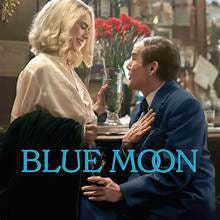
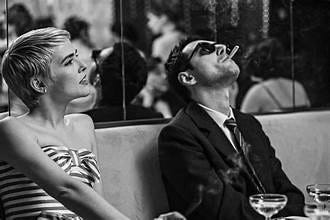
More on these most recent Linklater works, in Academic Film Viewing: 4.